
Sri Vidya Upasanam: The Sacred Path of Goddess Lalita Tripurasundari
Long ago, the sage Agastya is said to have approached Lord Hayagriva, seeking the highest knowledge. Hayagriva did not speak of rituals or wealth. He spoke of the Divine Mother, the one whose radiance is the source of all creation. He revealed to Agastya the thousand names of Lalita, the Lalita Sahasranama, and the secret path to worship her. That path is Sri Vidya, one of the most revered and closely guarded spiritual traditions of India.

What Is Sri Vidya Upasanam?
Sri Vidya is the worship of the Divine Mother in her form as Lalita Tripurasundari, also known as Rajarajeshwari and Shodashi. “Vidya” means knowledge, and “Sri” means auspiciousness, beauty and divine grace. Upasanam means devoted worship, literally “sitting near” the Divine.
Sri Vidya is both a path of devotion and a path of knowledge. It teaches that the whole universe is the play of one supreme consciousness, Shiva, and his power, Shakti, who are inseparable.
Worship of the Divine Mother as the supreme reality
Combines mantra, yantra, meditation and ritual
Leads to inner peace, wisdom and liberation (moksha)
Traditionally taught by a guru to a disciple
Who Is Goddess Lalita Tripurasundari?
Lalita is the Divine Mother seated on the Sri Chakra, radiant like the rising sun, holding a sugarcane bow, flower arrows, a noose and a goad. The sugarcane bow stands for the mind, the flower arrows for the five senses, the noose for attachment and the goad for aversion. She holds them all in her hands, showing that she is the mistress of the mind and senses.
The name Tripurasundari means “the beauty of the three worlds”. She is the Mother who is both infinitely gracious and supremely powerful.

The Birth of Lalita: The Story of the Chidagni Kunda
According to the Lalita Upakhyana of the Brahmanda Purana, after Lord Shiva burnt Kamadeva to ashes, a demon named Bhandasura arose from those ashes. He grew so powerful that even the Devas could not stand against him. In their distress, the Devas performed a great yajna, offering themselves into the sacred fire pit called the Chidagni Kunda, the fire of pure consciousness.
From that fire, the Divine Mother appeared in her radiant form as Lalita Tripurasundari, ready to restore dharma.
She rode the Sri Chakra chariot, the Chakra Raja Ratha
Her commanders were Mantrini (Rajashyamala) and Dandini (Varahi)
She defeated Bhandasura and his forces and restored the Devas
This story is the background of the Lalita Sahasranama
The Three Pillars of Sri Vidya
Sri Vidya worship rests on three sacred elements.
Mantra: The Panchadashi (fifteen-syllable) and Shodashi (sixteen-syllable) mantras are the heart of the tradition. They are received only through initiation.
Yantra: The Sri Chakra, a geometric form made of nine interlocking triangles, represents the universe and the body of the Goddess.
Guru: The lineage and guidance of a qualified teacher are considered essential.
The Mantras of Sri Vidya
The mantras of Sri Vidya are called bijaksharas, sacred seed syllables, each carrying the power of the Goddess. They are arranged in three sections called kutas.
Vagbhava Kuta: ka e ī la hrīṁ
Kamaraja Kuta: ha sa ka ha la hrīṁ
Shakti Kuta: sa ka la hrīṁ
Together, these fifteen syllables form the Panchadashi mantra. When the bija śrīṁ is added at the end, it becomes the sixteen-syllable Shodashi mantra, which is why the Goddess is also called Shodashi.
Panchadashi: ka e ī la hrīṁ – ha sa ka ha la hrīṁ – sa ka la hrīṁ
Shodashi: the Panchadashi followed by śrīṁ
Bala mantra: aiṁ klīṁ sauḥ, the seed mantra of Bala Tripurasundari, the child form of the Goddess, often the first mantra given to a disciple
Each syllable is understood to carry layers of meaning. The three kutas are said to correspond to the three parts of the Goddess’s subtle body, from the head to the heart to the base, and to the three powers of knowledge, desire and action. In the tradition, these mantras are not just chanted but are inwardly realised through years of practice.
The Sri Chakra: The Yantra of the Universe
The Sri Chakra, also called the Sri Yantra, is the most important symbol of this tradition. It is formed of four upward triangles representing Shiva and five downward triangles representing Shakti, together creating 43 smaller triangles. It is surrounded by lotus petals, circles and a square gateway called the bhupura.
Worshipped in the center (the bindu) as the seat of Lalita
Has nine avaranas, or enclosures, each guarded by Shakti deities
Often made in copper, silver, gold or crystal, or carved in stone
Represents the journey from the outer world to the inner Self
Worship of the Sri Chakra, called Sri Chakra Puja or Navavarana Puja, is a progression through these nine enclosures towards the center.
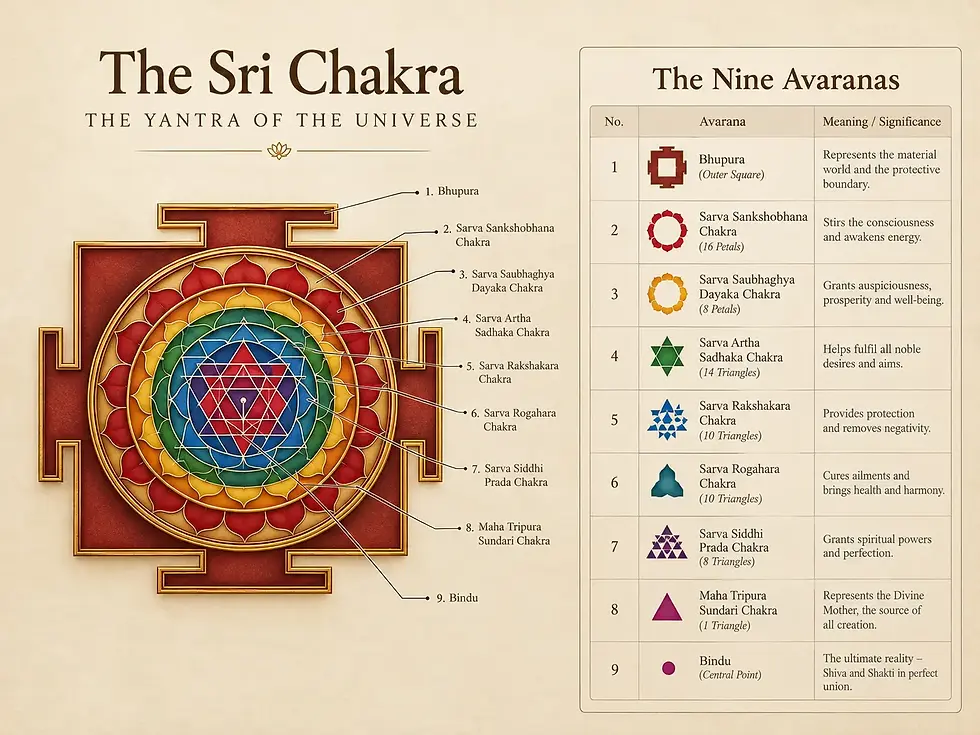
The Nine Enclosures: Navavarana of the Sri Chakra
The Sri Chakra has nine avaranas, or enclosures. Worship begins from the outermost layer and moves inward toward the bindu, the seat of the Goddess.
Avarana | Name | Form |
1 | Trailokya Mohana Chakra | Three-lined square (bhupura) |
2 | Sarvashaparipuraka Chakra | Sixteen-petalled lotus |
3 | Sarvasamkshobhana Chakra | Eight-petalled lotus |
4 | Sarvasaubhagyadayaka Chakra | Fourteen triangles |
5 | Sarvarthasadhaka Chakra | Ten outer triangles |
6 | Sarvarakshakara Chakra | Ten inner triangles |
7 | Sarvarogahara Chakra | Eight triangles |
8 | Sarvasiddhiprada Chakra | Central triangle |
9 | Sarvanandamaya Chakra | The bindu |
Each enclosure has its own presiding Shaktis. The journey through them is understood as the movement of the soul from the outer world to the experience of pure bliss.
Sacred Texts of Sri Vidya
Several texts shape this tradition.
Lalita Sahasranama: The thousand names of the Goddess, from the Brahmanda Purana
Lalita Trishati: Three hundred names, taught by Hayagriva
Soundarya Lahari: Attributed to Adi Shankaracharya, a poetic hymn of 100 verses
Tripura Rahasya and Devi Mahatmya: Philosophical and devotional works on the Goddess
Kamakshi Stotras and Lalita Upakhyana: Stories and hymns of Lalita
The Lineage of Sri Vidya
The tradition is said to have been passed down through great sages and teachers, including Hayagriva, Agastya, Durvasa and Parashurama. In South India, it is closely tied to the Sri Vidya lineages of Kanchipuram and the Kamakoti Peetham, and to Adi Shankaracharya, who is believed to have established the Sri Chakra at several temples.
Sri Vidya in Carnatic Music
Sri Vidya has also shaped South Indian classical music. Muthuswami Dikshitar, one of the Carnatic Trinity, was an initiated Sri Vidya upasaka. He composed the Navavarana Kritis in praise of Goddess Kamalamba at Thiruvarur, one kriti for each avarana of the Sri Chakra. These compositions are sung and studied to this day, carrying the philosophy of Sri Vidya into concert halls and temples.
Sri Vidya and Temple Worship
Many temples honour Lalita in the form of the Sri Chakra.
Kanchi Kamakshi Amman Temple, Kanchipuram: The Goddess is worshipped with a Sri Chakra before her
Thirumeyachur Lalithambigai Temple, Tamil Nadu: Famous for Lalita Sahasranama traditions
Sringeri Sharada Peetham, Karnataka: Associated with the Sri Chakra worship of the Shankaracharya tradition
Auspicious Days for Sri Vidya Worship
Navaratri: The most important period, when the Goddess is worshipped for nine nights
Lalita Panchami: Observed on the fifth day of Navaratri in honour of Lalita
Pournami (full moon): Considered especially auspicious for Lalita worship, with Lalita Sahasranama recitation
Fridays: A weekly day of Devi worship with lamps, flowers and kumkum
Aadi Pooram and Aadi Fridays: Special days for Amman worship in Tamil Nadu
Daily Practice and Etiquette
Sri Vidya has a gentle side that anyone can approach with devotion, even without initiation.
Chanting the Lalita Sahasranama or Lalita Ashtottara
Reciting the Soundarya Lahari
Lighting a lamp and offering flowers and kumkum to the Goddess
Observing Fridays and Navaratri with special worship
Traditionally, these mantras are chanted with correct pronunciation, intonation and the right method, which is taught by a guru during diksha. This article shares them for knowledge and reverence, and seekers are encouraged to learn the practice from a qualified teacher.
Sri Chakra and Devi Idols in Sculpture
For centuries, artisans have created Lalita Tripurasundari idols and Sri Chakra yantras in bronze, stone and metal. A properly crafted Devi idol follows the rules of the Shilpa Shastras, with the right proportions, the lotus seat, the four hands holding the bow, arrows, noose and goad, and a serene, smiling face.
FAQs
What is Sri Vidya Upasanam?
Sri Vidya Upasanam is the worship of the Divine Mother as Goddess Lalita Tripurasundari. It combines mantra, yantra, meditation and ritual, and is both a path of devotion and a path of knowledge.
Who is Goddess Lalita Tripurasundari?
Lalita Tripurasundari, also known as Rajarajeshwari and Shodashi, is the form of the Divine Mother worshipped in Sri Vidya. She is described as seated on the Sri Chakra, holding a sugarcane bow, flower arrows, a noose and a goad. Her name means “the beauty of the three worlds”.
Can anyone chant the Lalita Sahasranama?
Yes. The Lalita Sahasranama is widely chanted by devotees from all backgrounds, and many families recite it daily or on Fridays.
Is initiation required for Sri Vidya?
For the Panchadashi and Shodashi mantras and Sri Chakra Puja, the tradition requires diksha from a qualified guru. Hymns like the Soundarya Lahari and Lalita Sahasranama can be recited with devotion without initiation.
What is the difference between Sri Chakra and Sri Yantra?
They refer to the same sacred diagram. “Sri Chakra” is the term more common in worship, and “Sri Yantra” is the more general name.
What is the Panchadashi mantra?
The Panchadashi is the fifteen-syllable mantra of Goddess Lalita, arranged in three sections called kutas. When the bija “śrīṁ” is added, it becomes the sixteen-syllable Shodashi mantra. These mantras are traditionally received from a guru.
Conclusion
Sri Vidya Upasanam is more than a ritual. It is a way of seeing the world as the Divine Mother’s own form, and of finding beauty, peace and freedom through her grace. Whether you simply chant her thousand names or follow the full path under a guru, the essence stays the same: approach the Mother with love, and she responds with grace.



Comments