
FROM ONE BODY, 51 SACRED PLACES THE DIVINE STORY OF THE SHAKTI PEETHAS
The Divine History of the Shakti Peethas
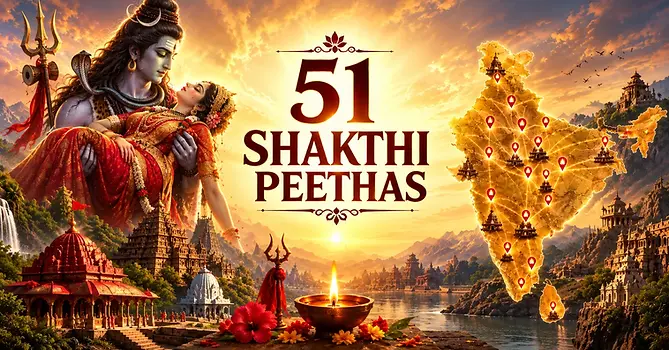
In India's spiritual history, the Shakti Peethas hold a place of singular importance among the sacred sites dedicated to Mother Shakti. According to the Puranas, the history of the Shakti Peethas begins with a pivotal divine event connected to Sati Devi, Lord Shiva, Daksha Prajapati, and Lord Vishnu. Daksha's yagna, Sati Devi's sacrifice, and Lord Shiva's grief form the central threads of this story.
It is said that after Sati Devi's passing, Lord Shiva wandered the world in deep sorrow, carrying her body with him. As this began to disturb the balance of the universe, the Puranas recount that Lord Vishnu intervened using his Sudarshana Chakra. The places where Sati Devi's body parts or ornaments are believed to have fallen came to be revered as the Shakti Peethas sacred sites imbued with the grace of Mother Shakti that continue to be worshipped by devotees to this day.
Sati Devi, Daughter of Daksha Prajapati
Born as the daughter of Daksha Prajapati, Sati Devi held deep devotion for Lord Shiva from a very young age. She lived with the unwavering wish to have him as her husband, and her love and devotion toward Shiva remained steadfast throughout her life.
However, Daksha Prajapati did not approve of Shiva. He disliked Shiva's simple, ascetic way of life and his appearance, which differed so greatly from that of other gods. Even so, Sati never wavered in her resolve. She remained firm in her determination to marry none other than Lord Shiva.
Sati's Marriage and Daksha's Resentment
In accordance with her wish, Sati married Lord Shiva. Her choice of Shiva as her husband reflected both her resolve and the depth of her devotion. Yet this marriage brought Daksha Prajapati no joy whatsoever.
Daksha could not accept that his daughter had married Shiva. The resentment he already held toward Shiva's lifestyle and appearance only deepened after the marriage, and the hostility between Daksha and Shiva grew increasingly severe.
Daksha's Yagna and the Humiliation of Sati
One day, Daksha Prajapati decided to conduct a grand yagna, to which he invited numerous gods, sages, and kings. However, no invitation was extended to Lord Shiva or Sati Devi. Upon learning of this, Sati wished to attend her father's yagna regardless. Shiva tried to stop her, advising that it would not be right to go uninvited. Still, since it was her father's home, Sati went to the yagna alone.
When she arrived, Daksha did not welcome her with love. Instead, he spoke disparagingly of both Shiva and Sati. Unable to bear the insult directed at her husband, Sati was overwhelmed with anguish at what had unfolded because of her own father's actions.
Sati's Sacrifice and Shiva's Fury

Sati could not accept the insult Daksha had heaped upon Lord Shiva. Heartbroken by the humiliation her husband had suffered, she offered herself into the sacrificial fire as an act of protest against her father's conduct. News of Sati's death plunged Shiva into profound grief. The pain of losing his beloved consort, combined with his fury at Daksha, intensified his rage beyond measure.
The Puranas describe how Shiva's wrath took on a terrifying form. Veerabhadra emerged from his matted locks, and Bhadrakali manifested as a fierce embodiment of divine power. As the story continues, at Shiva's command, they descended upon Daksha's yagna and destroyed everything there.
Veerabhadra's Fury and Daksha's Punishment
Following Shiva's command, Veerabhadra and Bhadrakali went to the site of Daksha's yagna. Enraged by the insult inflicted upon Sati, they laid waste to the ceremony. The gods, sages, and others gathered there also bore the brunt of their fury, and Daksha himself received severe punishment for his actions.
Later, moved by the tears and pleas of Daksha's wife, Shiva's anger subsided. Taking pity on Daksha, Shiva restored him to life. According to the Puranic account, Daksha's head was replaced with that of a goat. This act is regarded both as the end of Daksha's arrogance and as an expression of Shiva's compassion.
Shiva's Tandava with Sati's Body

Even after Daksha's yagna had ended, Shiva could not recover from the grief of losing Sati. Carrying his beloved wife's body, he wandered the entire world, utterly consumed by the sorrow of separation. The Puranas describe how, in this anguish, Shiva performed a violent, fierce Tandava dance.
This intense state of Shiva's began to disturb the very order of the universe. The gods and sages watched with growing alarm, and it became necessary to bring an end to Shiva's grief and restore peace and balance to the world. The Puranic narrative continues with Lord Vishnu undertaking a crucial act to resolve this crisis.
Sati's Body Parts and the 51 Shakti Peethas
According to the Puranas, in order to end Shiva's grief and restore balance to the universe, Lord Vishnu employed his Sudarshana Chakra. Through this act, it is believed that Sati's body was divided into many parts, which fell in different locations across the earth.
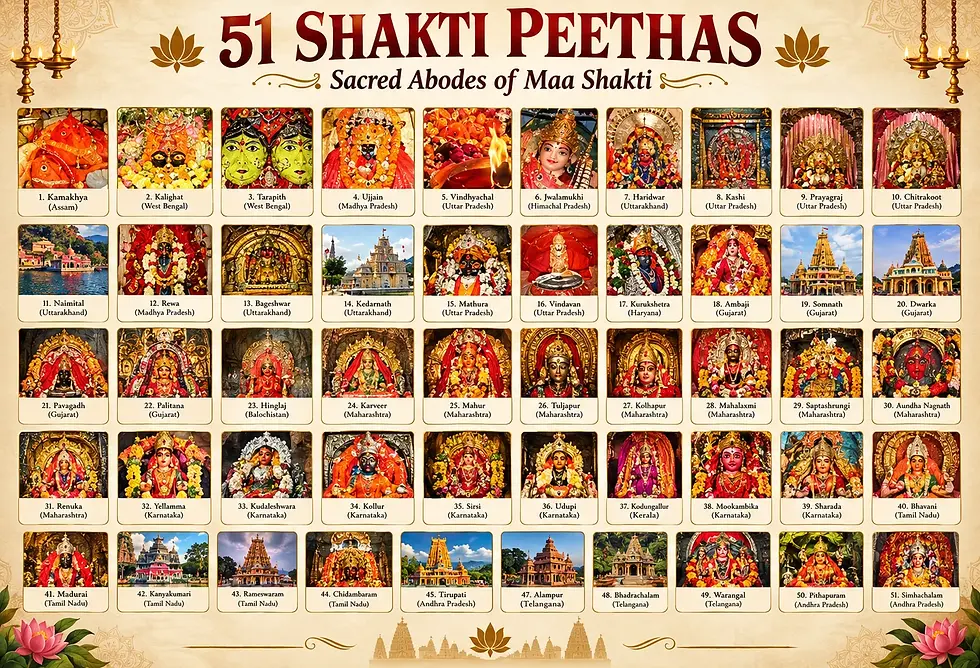
The places where these parts of Sati's body are believed to have fallen came to be revered as the Shakti Peethas. Hindu tradition recognizes 51 Shakti Peethas, each associated with a specific form of Mother Shakti.
At every Shakti Peetha, the worship of Bhairava is believed to accompany that of Mother Shakti. As a result, each Shakti Peetha stands as a sacred site with its own distinct divine form, Puranic history, and spiritual significance.
The Complete List of the 51 Shakti Peethas
No | Shakti Peetha / Location | Name of the Goddess | Body Part / Ornament Fallen | Name of Bhairava |
1 | Amarnath, Jammu & Kashmir | Mahamaya | Throat | Trisandhyeswarar |
2 | Kangra (Jwalamukhi), Himachal Pradesh | Siddhida (Ambika) | Tongue | Unmatta Bhairava |
3 | Jalandhar, Punjab | Tripuramalini | Left breast | Bheeshana Bhairava |
4 | Pushkar (Gayatri Peetha), Rajasthan | Gayatri | Both wrists | Sarvanandar |
5 | Mathura, Uttar Pradesh | Uma (Katyayani) | Hair | Bhuteswarar |
6 | Varanasi (Kashi), Uttar Pradesh | Visalakshi | Earring / Manikundalam | Kala Bhairava |
7 | Prayagraj (Allahabad), Uttar Pradesh | Lalita (Alopi Mata) | Fingers | Bhava Bhairava |
8 | Gaya, Bihar | Mangalagauri | Breast region | Prabhanna Bhairava |
9 | Patna, Bihar | Sarvajayanti (Patan Devi) | Right thigh | Vyomakesha Bhairava |
10 | Kamakhya (Guwahati), Assam | Kamakhya | Yoni (genitals) | Umananda |
11 | Jajpur, Odisha | Biraja (Girija) | Navel | Jagannatha Bhairava |
12 | Ujjain, Madhya Pradesh | Mahakali | Upper lip | Lambakarna Bhairava |
13 | Indore (Bhairav Parvat), Madhya Pradesh | Avanti | Upper teeth | Kapali Bhairava |
14 | Ambaji, Gujarat | Ambaji (Mahishasuramardini) | Heart | Batuk Bhairava |
15 | Junagadh (Girnar), Gujarat | Chandrabhaga | Stomach | Vakratunda Bhairava |
16 | Kolkata (Kalighat), West Bengal | Dakshina Kali | Right toes | Nakuleswarar |
17 | Bolpur (Vakreswar), West Bengal | Mahishasuramardini | Between the eyebrows | Vakranathar |
18 | Santipur (Nandipur), West Bengal | Nandini | Neck ornament | Nandikeswarar |
19 | Labpur (Attahasa), West Bengal | Phullara | Lower lip | Visweswarar |
20 | Nalhati, West Bengal | Kalika | Larynx | Yogish Bhairava |
21 | Darbhanga (Mithila), Bihar | Uma (Mahadevi) | Left shoulder | Mahodara Bhairava |
22 | Murshidabad (Kiritkona), West Bengal | Vimala | Crown / head | Samvarta Bhairava |
23 | Radhakishorepur, Tripura | Tripurasundari | Right foot | Tripuresh Bhairava |
24 | Kankalitala (Bhababhumi), West Bengal | Devagarbha | Womb | Rudra Bhairava |
25 | Malda (Bakula), West Bengal | Bhavani | Left hand | Piru Bhairava |
26 | Burdwan (Ujani), West Bengal | Mangala Chandi | Right wrist | Kapilambara Bhairava |
27 | Burdwan (Kshirgram), West Bengal | Yogadya | Right big toe | Kshirakanda Bhairava |
28 | Tamluk (Vibhasa), West Bengal | Kapalini | Left ankle | Sarvananda Bhairava |
29 | Jalpaiguri, West Bengal | Bhramari | Left leg | Eshwar Bhairava |
30 | Puri (Jagannath Temple), Odisha | Vimala | Tongue / feet | Jagannatha |
31 | Kurnool (Srisailam), Andhra Pradesh | Bhramaramba | Neck area | Sambaranandar |
32 | Eluru (banks of Godavari), Andhra Pradesh | Vishwamukhi | Left cheek | Dandapani |
33 | Pithapuram, Andhra Pradesh | Puruhutika Devi | Left hand | Kukkuteswarar |
34 | Nashik (Panchavati), Maharashtra | Bhramari (Bhadrakali) | Chin | Vikrateswarar |
35 | Kolhapur, Maharashtra | Mahalakshmi | Eyes | Krodhish Bhairava |
36 | Tuljapur, Maharashtra | Bhavani Devi | Right hand | Sarvadeva Bhairava |
37 | Kanyakumari, Tamil Nadu | Bhagavathi Amman | Back | Nimisha Bhairava |
38 | Kanchipuram, Tamil Nadu | Kamakshi Amman | Waist belt (Ottiyanam) | Ekambareswarar |
39 | Madurai, Tamil Nadu | Meenakshi Amman | Eyes / shoulders | Sundareswarar |
40 | Srinagar, Jammu & Kashmir | Sharada Devi | Right hand | Mahabhairava |
41 | Deoghar, Jharkhand | Jai Durga | Heart / ear | Vaidyanath |
42 | Panwaseswar, Himachal Pradesh | Mahasaraswati | Upper jaw | Bhotar Bhairava |
43 | Mirpur, Jammu & Kashmir | Katyayani | Left hand | Kala Bhairava |
Shakti Peethas in Neighboring Countries (Parts of Akhand Bharat)
No | Shakti Peetha / Location | Name of the Goddess | Body Part Fallen | Name of Bhairava |
44 | Hinglaj, Balochistan (Pakistan) | Hinglaj Mata (Kottari) | Brahmarandhra (crown of the head) | Bhimalochana Bhairava |
45 | Sitakunda, Chittagong (Bangladesh) | Bhavani | Right hand | Chandrasekhara |
46 | Ishwaripur, Jessore (Bangladesh) | Jashoreswari | Palms and feet | Chanda Bhairava |
47 | Bogra, Bhawanipur (Bangladesh) | Aparna | Left anklet | Vamana Bhairava |
48 | Shikarpur, Faridpur (Bangladesh) | Sugandha | Nose | Tryambaka Bhairava |
49 | Sylhet, Jayantiapur (Bangladesh) | Jayanti | Left thigh | Kramadishwarar |
50 | Mustang (banks of the Kandaki River), Nepal | Gandaki Chandi | Forehead / cheek | Chakrapani |
51 | Trincomalee, Sri Lanka | Sankari Devi | Anklets | Rakshaseswarar |
Bhairava, Guardian of the Shakti Peethas
As Sati's body parts fell across various places on earth, each of those locations became a sacred site of Mother Shakti. Mother Shakti began bestowing her grace in different forms at each of these places. At that time, Lord Shiva resolved that these sacred sites should be protected from any harm.
For this purpose, Bhairava the fierce manifestation of Lord Shiva went to stand guard at each Shakti Peetha. Bhairava took it upon himself to remain stationed around the site where Mother Shakti bestowed her grace, protecting that sacred ground. It is said that whenever devotees come to seek the Goddess's darshan, Bhairava watches over their worship.
For this reason, Bhairava came to hold an important place alongside Mother Shakti in the story of the Shakti Peethas. Mother Shakti is regarded as the deity who bestows grace, while Bhairava is honored as the guardian of that sacred site. This story remains the key reason why, even today, Bhairava is worshipped together with Mother Shakti at many of the Shakti Peethas.
FAQs
What are the 51 Shakti Peethas?
The 51 Shakti Peethas are sacred pilgrimage sites believed to be connected with different parts of Goddess Sati’s body.
How did the 51 Shakti Peethas originate?
According to the traditional story, the Shakti Peethas were formed when parts of Sati’s body fell at different places while Lord Shiva carried her.
What is the story of Sati and Lord Shiva?
Sati, the daughter of Daksha, married Lord Shiva. After Daksha insulted Shiva during a sacrifice, Sati gave up her life, leading to the divine events that created the Shakti Peethas.
Why did Sati sacrifice herself?
Sati was deeply hurt by her father Daksha’s disrespect toward Lord Shiva and chose to sacrifice herself at his yajna.
Why did Lord Shiva carry Sati’s body?
Overcome with grief after Sati’s death, Lord Shiva carried her body and wandered across the universe.
What did Lord Vishnu do to restore cosmic balance?
Lord Vishnu used his Sudarshana Chakra to separate Sati’s body, helping Lord Shiva overcome his grief and restoring cosmic balance.
What are the benefits of using bronze idols for worship?
Bronze idols are valued for their durability, traditional craftsmanship, detailed designs, and long-lasting beauty, making them suitable for regular worship and devotional spaces.
Why should I choose handcrafted bronze God idols?
Handcrafted bronze God idols are valued for their traditional craftsmanship, unique detailing, durability, and timeless beauty, making them a meaningful choice for home pooja and devotional spaces.
Why are the Shakti Peethas sacred to Goddess Shakti?
Each Shakti Peetha is believed to represent the divine presence and power of Goddess Shakti.
Why is Bhairava considered the guardian of the Shakti Peethas?
In traditional belief, Bhairava protects and watches over the sacred Shakti Peetha and its divine Shakti.
Comments