
One Lesson in Humility: The Story of Ravana and Lord Shiva

Imagine the strongest king in the world, with ten heads, twenty arms, and a flying chariot, standing in front of a mountain and deciding to pick it up. Now imagine that mountain being held down by a single toe. That is the story of Ravana and Lord Shiva on Mount Kailash. It is told in homes and temples across India, and it still teaches one of life's simplest lessons: no matter how strong we become, humility matters more.
The Story in Short
Ravana, the mighty king of Lanka, once tried to lift Mount Kailash, the home of Lord Shiva. Shiva pressed the mountain down with just his toe and trapped Ravana underneath. In pain, Ravana sang a hymn of praise, and Shiva forgave him.
This is one of the most loved stories about pride and humility in Indian mythology. It is easy to remember because the picture is so clear: the strongest king in the world, stuck under a mountain, held down by a single toe. Below, the story is told slowly and simply, step by step, with a short explanation after each part so that every reader, young or old, can follow it.
Words You Will See in This Story
Word | Simple meaning |
Kailash | The sacred snow mountain in the Himalayas where Shiva lives |
Nandi | Shiva's bull and the guard of his home |
Pushpaka Vimana | Ravana's flying chariot, taken from his brother Kubera |
Veena | A string instrument, like a long, stringed guitar, played in India |
Stotram | A hymn or song of praise |
Chandrahasa | The divine sword Shiva gave to Ravana |
Vanara | A forest-dwelling being in the Ramayana, often described as monkey-like |
"The Story of Ravana and Lord Shiva"
Who Was Ravana?
Ravana was the ten-headed king of Lanka. His father was the sage Vishrava and his mother was Kaikesi, a rakshasa princess. So he came from two worlds: the world of wise sages and the world of mighty warriors.
He was not a simple villain in the old stories. He knew the Vedas, he was a skilled veena player, and he ruled a rich and well-run kingdom. He had also defeated many kings, and even the guardians of the gods.
Most importantly, he was a deep devotee of Lord Shiva. He had done long and difficult penance for him and had received powerful boons in return.
But Ravana had one big weakness. He was very proud of his own strength, and that pride is what this whole story is about.
Part 1: Ravana Arrives at Kailash
Ravana, the king of Lanka, was a man of great learning, music and valor. The boons he had earned through austere penance made him nearly invincible. But with each victory, his pride grew along with his power.

One day, he was flying north in his chariot, the Pushpaka Vimana.
Among the Himalayan peaks, he saw Mount Kailash shining like silver.
This mountain was the sacred home of Lord Shiva and Goddess Parvati.
As he approached, his chariot trembled and came to a halt in mid-air.
No matter how hard he tried, the chariot would not move forward. Ravana climbed down to find out what was stopping him.
Part 2: Nandi Stops Ravana
At the gate of Kailash stood Nandi, the faithful guardian of Lord Shiva. He calmly informed Ravana that the Lord was in deep meditation and that no one was allowed to enter.
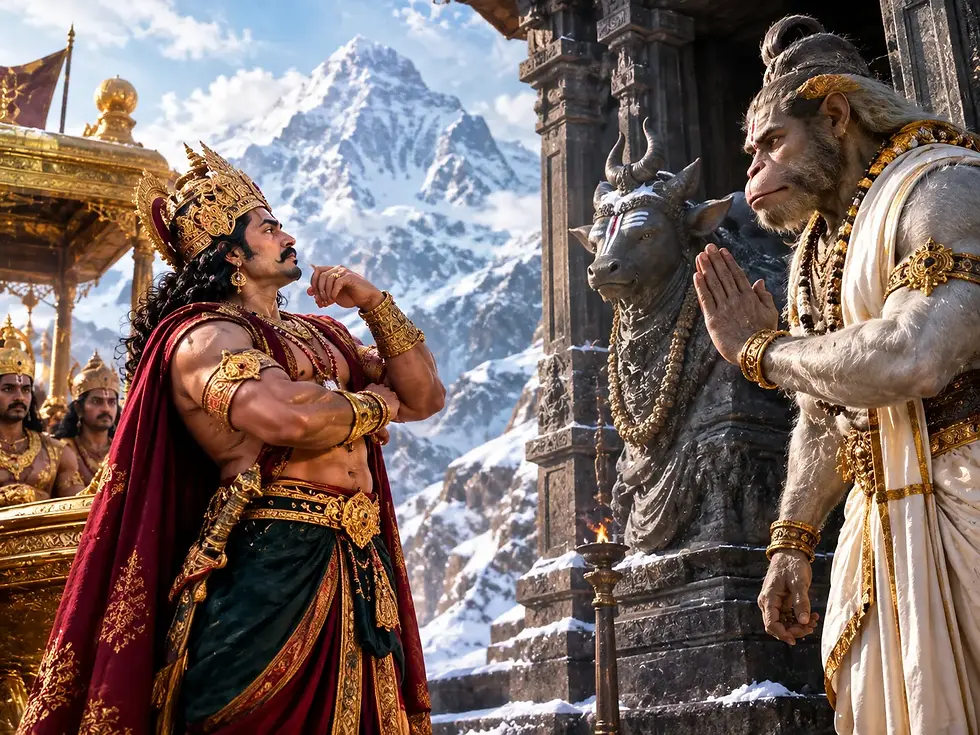
Ravana spoke of his power and fame, hoping to be let through.
Nandi remained firm, saying the rule of Kailash was the same for kings and commoners alike.
Angered, Ravana laughed and mocked Nandi's appearance, comparing his face to that of a monkey.
Nandi reminded him that true greatness lies in the heart, not in the body.
He then cursed Ravana, saying that monkeys would one day be the cause of Lanka's burning.
Ravana brushed the curse aside. Since the mountain would not let him pass, he decided to uproot the mountain itself and carry it away.
Part 3: Ravana Tries to Lift the Mountain
Blinded by pride, Ravana pushed his twenty arms beneath the mountain. Gathering all his strength, he began to shake Kailash.

The mountain began to tremble, and rocks tumbled down its slopes.
Trees toppled, and streams changed their course.
Wild creatures fled in fear in every direction.
The attendants of Shiva stood stunned.
Goddess Parvati was startled and clung to Lord Shiva.
Ravana took the shaking of the mountain as a sign of his success and pushed even harder. He had crossed every limit and disturbed the peace of the Lord himself.
Part 4: Shiva Presses Down with His Toe
Lord Shiva knew everything that was happening. He understood that the time had come to teach Ravana a lesson. Without anger or fuss, he gently pressed the mountain down with the tip of his toe.

That one small touch settled Kailash firmly back in its place.
Ravana's arms, still beneath the mountain, were trapped between the rocks.
He could neither move nor pull his arms free.
His pride, the belief that no one could stop him, shattered in an instant.
The man who had conquered the world could not bear the weight of a single toe.
Part 5: The Roar That Gave Ravana His Name
In the agony of his crushed arms, Ravana let out a mighty cry. It echoed through all three worlds.
The force of his voice made the sky and the earth shake.
The gods and sages trembled when they heard it.
Because of this tremendous roar, the name Ravana stayed with him.
The name means "one who roars" or "one who cries out loud."
He had arrived full of pride, yet that cry gave him a new name in history. The name would forever remind him of his defeat.
Part 6: The Song from Under the Mountain
It is said that he suffered under the mountain for a thousand years. At last, his ministers and elders advised him that the only way to win the Lord's grace was to praise him in song.
Ravana let go of his pride and turned to Shiva with true devotion.
He pulled out a sinew from his own arm and used it as a string for his veena.
He played the instrument and sang hymns from the Sama Veda in praise of Shiva.
Even in his pain, his music flowed without a break.
His humility and regret could be heard in every note.
Years passed, yet the music never stopped. Rising from beneath Mount Kailash, the song finally reached the ears of the Lord.
Part 7: Shiva Forgives Ravana
Lord Shiva saw that there was real change in Ravana's heart, in both his music and his devotion. Pleased, he lifted his toe and set Ravana free.
Ravana's arms were released from under the mountain.
Lord Shiva blessed him with a sword named Chandrahasa.
He also granted him the blessing of a long life.
Ravana bowed with humility, understood his mistake, and took his leave.
The lesson of this story is simple:
Strength, however great, leads to downfall without humility.
Pride can hide even knowledge and talent.
True devotion and repentance win the grace of God.
What Happened After
Ravana returned to Lanka, but the lesson did not last. Over time, his pride came back, and it led him to the events of the Ramayana, where he took Sita away and was finally defeated by Lord Rama.
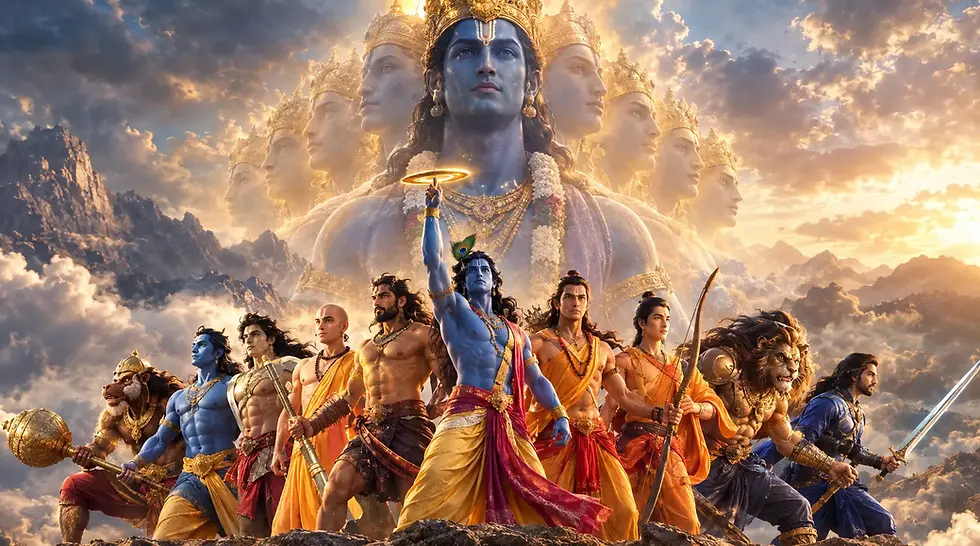
Nandi's warning also came true. An army of vanaras, led by Hanuman and Sugriva, helped Rama in his fight against Lanka.
The story of Kailash shows that even a person who has learned humility once can forget it.
Why Did Shiva Use Only His Toe?
Many readers ask this question, and the answer is the heart of the story.
Shiva did not need to fight because he was never in a competition. For Ravana, lifting Kailash was a test of strength. For Shiva, it was a small thing that needed only a small move.
It also shows a key idea in Indian thought: real power is quiet. The more secure a person is, the less he needs to shout or fight.
The Lesson in Humility
Pride is fragile. Ravana had knowledge, wealth, and power, yet he was stopped by a single toe. Anything that depends on showing off can fall quickly.
True strength is calm. Shiva did not fight. He stayed still and was far stronger.
Pain can teach. Only when Ravana was stuck and helpless did he turn inward and remember his devotion. Sometimes a hard time is what makes us pause and think.
Surrender is not weakness. Ravana received through his humble song what he could never get by force. Saying sorry or bowing down, when it is honest, takes courage.
Humility must be practised daily. Ravana learned it once and forgot it, which is why the lesson stays relevant for everyone.
Conclusion
The story of Ravana and Lord Shiva is simple, and that is why it stays with us. A powerful king believed he could move a mountain. A single toe showed him he could not. In his helplessness, he found the humility that his strength had hidden from him.
The next time pride tells us we are too strong to bow, this story is worth remembering. Ravana had everything, but he forgot to stay humble, and that is the lesson that lasts.
FAQs
What is the story of Ravana and Lord Shiva?
Ravana, a great king and devotee of Shiva, tried to lift Mount Kailash out of pride. Shiva pressed the mountain down with his toe and trapped him. Ravana then sang the Shiva Tandava Stotram, and Shiva freed and blessed him.
Why did Ravana try to lift Mount Kailash?
Nandi stopped his chariot at Kailash, and Ravana, angry and proud of his strength, decided to lift the mountain itself.
How did Ravana get his name?
In the Ramayana's telling, the loud cry he let out under the mountain earned him the name Ravana, "the one who roars."
What is the Shiva Tandava Stotram?
It is a Sanskrit hymn praising Shiva's cosmic dance. Tradition attributes it to Ravana, composed while he was trapped under Kailash.
What was the sword Chandrahasa?
It was a divine sword Shiva gave Ravana after forgiving him.
Was Ravana a devotee of Shiva?
Yes. Ravana is remembered as one of Shiva's greatest devotees, which is why this story is so striking: even a devotee can lose his way when pride takes over.
How long was Ravana trapped under Kailash?
In the Ramayana's telling, it was a very long time, often said to be a thousand years.
What does the story teach us?
It teaches that pride is fragile and that real strength lies in humility, surrender, and devotion.

Comments