
THE NINE NIGHTS, NINE FORMS UNDERSTANDING NAVADURGA

Introduction
Every year, when the monsoon fades and the air turns a little cooler, India gets ready for Navratri. Homes are cleaned, lamps are lit, and temples fill up with devotees who have come to worship the Goddess in her most powerful forms. At the heart of these nine nights are the Navadurga, the nine forms of Goddess Durga, each one honoured on a particular day.
The nine forms are not nine separate goddesses competing for attention. They are nine faces of one Shakti, the divine energy that creates, protects and transforms the world. Together they trace a complete journey, from the innocence of a mountain princess to the wisdom of a goddess who grants perfection. In this blog, we will look at where the Navadurga tradition comes from, what each form stands for, how different parts of India celebrate her, and where you can visit her temples.
The Origin of Navadurga
The names of the nine forms come from the Devi Kavacha, a protective hymn that is traditionally recited along with the Devi Mahatmya, also known as the Durga Saptashati. This scripture is part of the Markandeya Purana, and it tells how the Goddess rose to defeat Mahishasura, the buffalo demon whom no god could overcome.
The Devi Kavacha lists the nine names in order: Shailaputri, Brahmacharini, Chandraghanta, Kushmanda, Skandamata, Katyayani, Kalaratri, Mahagauri and Siddhidatri. Read in sequence, they also read like a life story. The first forms stand for childhood, discipline and inner strength. The middle forms show creation, motherhood and courage in battle. The last forms take the devotee through the destruction of fear and ignorance to peace and spiritual fulfilment.
This is why the nine nights of Navratri are seen as more than a festival. They are a slow inward climb, and each night asks the devotee to take one more step.
Symbolism of the Nine Durga Forms
Each Navadurga has her own day, her own mount, her own objects in hand and her own message. Here is what each form represents.

Her name means "daughter of the mountain", and she is the form of Parvati as the daughter of Himavan, the Himalayas. She rides the bull Nandi and carries a trident in one hand and a lotus in the other. Worship begins with her because every spiritual journey needs a steady foundation, and she stands for stability, patience and the strength of the earth itself.

Brahmacharini is the goddess of penance. She is shown walking barefoot, dressed in white, with a rosary in one hand and a water pot in the other. She stands for years of quiet, sincere effort undertaken to reach a goal. Devotees pray to her for discipline, focus and the patience to keep going when results are slow.

Chandraghanta takes her name from the half-moon shaped like a bell on her forehead. She rides a tiger, has many arms carrying weapons, and looks ready for battle, yet her presence is calming. She teaches that courage and grace can live together, and she is worshipped for fearlessness and protection from negative forces.

Kushmanda is believed to have created the universe with a gentle smile, when nothing but darkness existed. Her name is often explained as the one who holds the cosmic egg, and she is pictured with eight arms and a lion as her mount. She is the source of light, energy and vitality, and people pray to her for good health and a bright outlook.
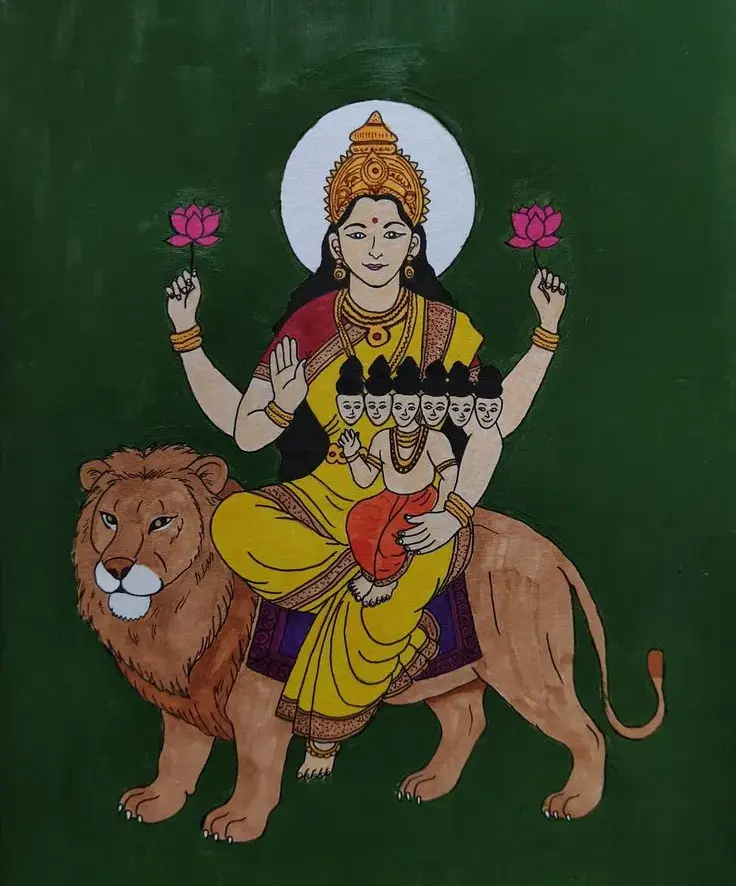
Skandamata is the mother of Skanda, also known as Kartikeya or Murugan, the commander of the divine army. She is seated on a lotus with her infant son on her lap, which is why she is also called Padmasana Devi. She represents the tenderness of a mother who is also a fierce protector, and she is worshipped for love, warmth and family well-being.

Katyayani is the warrior form who took birth in the family of the sage Katyayana. She is the form who slayed Mahishasura, and she is shown riding a lion with a sword and lotus in her hands. She is known as the goddess of courage and is also prayed to by young women seeking a good life partner.

Kalaratri is the darkest and most fearsome of the nine, with a dark complexion, wild hair and a donkey as her mount. Her fierce look is meant to frighten away fear, not the devotee. Even so, she is a form of great kindness, since she is also called Shubhankari, the one who brings auspiciousness. She is worshipped to remove fear, ignorance and obstacles.
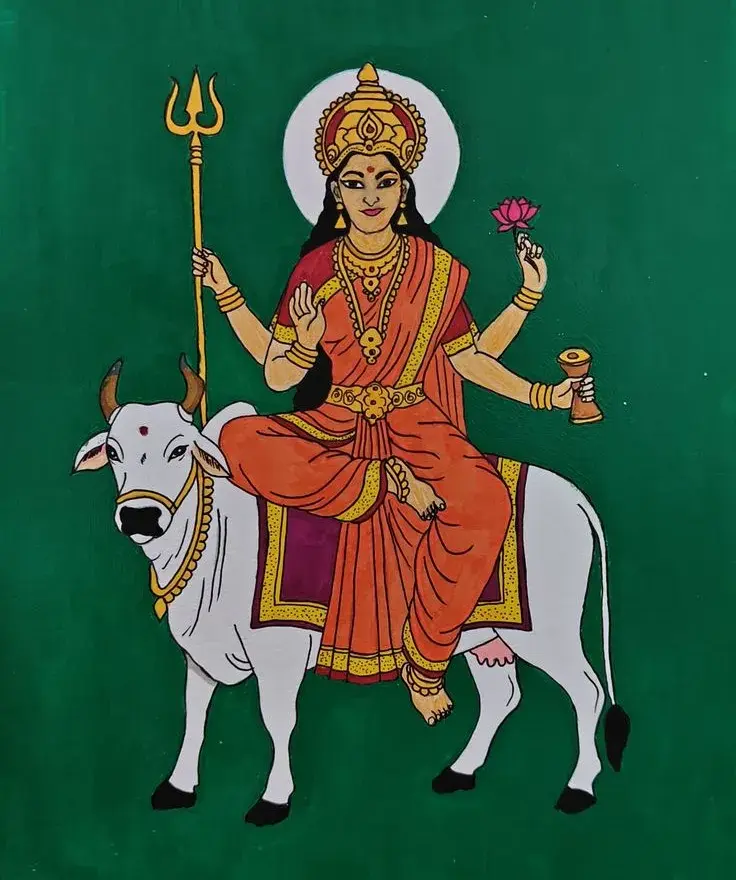
Mahagauri is radiant, fair and serene, dressed in white and riding a white bull. According to tradition, she gained her brilliance after long penance to win Shiva as her husband. She stands for purity, forgiveness and inner peace, and many devotees perform Kanya Pujan on this day.

Siddhidatri is the giver of siddhis, the spiritual accomplishments sought by sages and seekers. She sits on a lotus and holds a mace, discus, conch and lotus. She completes the journey of the nine nights and represents perfection, wisdom and liberation. Her blessings are believed to bring the fulfilment of sincere effort.
Navadurga at a Glance: Vahana, Symbols and Offerings
Each form of the Goddess comes with her own mount (vahana), sacred objects and a traditional offering. The details below are the most commonly followed ones, and they can vary slightly between regions and family traditions.
Day | Form | Vahana (Mount) | Symbols and Objects | Commonly Offered |
1 | Shailaputri | Bull (Nandi) | Trident and lotus | Pure ghee |
2 | Brahmacharini | Walks barefoot | Rosary (japamala) and water pot (kamandalu) | Sugar |
3 | Chandraghanta | Tiger | Bell-shaped crescent moon on the forehead; ten arms holding weapons | Milk or kheer |
4 | Kushmanda | Lion | Eight arms holding bow, arrow, discus, mace, lotus, rosary, water pot and a pot of nectar | Malpua |
5 | Skandamata | Lion (seated on a lotus) | Infant Skanda on her lap and two lotuses | Bananas |
6 | Katyayani | Lion | Sword and lotus, with abhaya and varada mudras | Honey |
7 | Kalaratri | Donkey | Sword and iron hook, with abhaya and varada mudras | Jaggery |
8 | Mahagauri | White bull | Trident and damaru, with abhaya mudra | Coconut |
9 | Siddhidatri | Lotus (sometimes a lion) | Mace, discus, conch and lotus | Sesame seeds |
Navadurga Worship Across India
The Goddess is one, but the way she is welcomed changes from state to state. Every region has added its own colour, food, music and craft to the celebration.
North India
In Uttar Pradesh, Bihar, Delhi and nearby states, devotees keep fasts through the nine days and end them with Kanya Pujan on Ashtami or Navami. Young girls are welcomed as living forms of the Goddess, their feet are washed, and they are served a meal and given gifts. In the evenings, many towns stage Ramlila, the folk-theatre retelling of the Ramayana, which builds up to the burning of Ravana's effigy on Dussehra.
West Bengal and Eastern India
In Bengal, Odisha and Assam, the festival is celebrated as Durga Puja. The Goddess is worshipped as Mahishasuramardini, the slayer of the buffalo demon, along with her children Lakshmi, Saraswati, Ganesha and Kartikeya. Neighbourhoods build elaborate pandals, and artisans spend months shaping idols. The festival ends on Vijayadashami with an emotional immersion of the idol in the river.
Gujarat and Maharashtra
In Gujarat, Navratri means Garba and Dandiya Raas. People gather in colourful traditional clothes to dance in circles around a lamp or an image of the Goddess, to the beat of devotional songs. Maharashtra shares in this joy, and also marks Ghatasthapana, the installation of a sacred pot on the first day.
South India
In Tamil Nadu, Andhra Pradesh, Telangana and Karnataka, homes set up Golu (Bommai Golu or Bommala Koluvu), a stepped display of dolls and figurines arranged in odd numbers of steps. Neighbours are invited to visit, and women exchange sundal, betel leaves and small gifts. The last days include Saraswati Puja and Ayudha Puja, when books, tools and vehicles are cleaned and worshipped. Mysuru is famous for its grand Dasara procession, and in Kerala children begin their first lessons on Vijayadashami in a ritual called Vidyarambham.
Himachal Pradesh
In the hills of Himachal, the season is marked by fairs and temple gatherings in places such as Kangra, and by the week-long Kullu Dussehra, where local deities are carried in colourful palanquins to the Dhalpur maidan. It is a lively mix of faith, folk music, dance and mountain crafts.
Famous Navadurga Temples in India
Varanasi has a traditional Navadurga circuit, where devotees try to visit the shrine of each of the nine forms during Navratri. Some of the forms are also strongly linked with temples in other cities. Local names and exact locations can differ between traditions, so it is a good idea to confirm details before you travel.
Shailaputri Temple, Varanasi (Uttar Pradesh): Located in the Alaipura area near the Marhia Ghat and visited especially on the first day of Navratri.
Brahmacharini Temple, Varanasi (Uttar Pradesh): Found near the Brahma Ghat on the banks of the Ganga.
Chandraghanta Temple, Varanasi (Uttar Pradesh): Located in the old city and visited on the third day.
Kushmanda Temple, Durga Kund, Varanasi (Uttar Pradesh): The Durga Kund temple is one of the best-known Durga shrines in the city and is especially associated with Kushmanda.
Skandamata Temple, Varanasi (Uttar Pradesh): Worshipped in the Jaitpura area on the fifth day.
Katyayani Temple, Vrindavan (Uttar Pradesh): The Katyayani Shakti Peeth in Vrindavan is among the most revered shrines of this form, and Katyayani is also worshipped in Varanasi.
Kalaratri Temple, Kalika Gali, Varanasi (Uttar Pradesh): Found in a narrow lane near the Kashi Vishwanath area.
Mahagauri Temple, Varanasi (Uttar Pradesh): Mahagauri is worshipped near the Annapurna temple, especially on Ashtami.
Siddhidatri Temple, Varanasi (Uttar Pradesh): Devotees visit on the last day to complete the circuit.
Conclusion
The Navadurga tell one story across nine nights: the Goddess who begins as a mountain's daughter, gathers strength through penance and courage, faces the darkest fear, and finally grants peace and perfection. Whether you celebrate through Garba in Gujarat, Golu in Tamil Nadu, Durga Puja in Kolkata or a quiet prayer at home, the message is the same. The divine feminine is within us as well as around us, and each form is a reminder of a quality we can awaken.
This Navratri, you may wish to pick one form each day and reflect on her message. It could be a small step, but it is a lasting way to take the festival beyond the rituals and into everyday life.
THE NINE NIGHTS, NINE FORMS UNDERSTANDING NAVADURGA
Frequently Asked Questions
What is Navadurga?
Navadurga means "the nine Durgas". These are the nine forms of Goddess Durga worshipped on the nine nights of Navratri, one form each day. They are not nine separate goddesses but nine aspects of one Shakti, the divine energy that creates, protects and transforms the world.
What are the nine forms of Durga in order?
The nine nights, nine forms understanding navadurga, in the order given in the Devi Kavacha, are Shailaputri, Brahmacharini, Chandraghanta, Kushmanda, Skandamata, Katyayani, Kalaratri, Mahagauri and Siddhidatri.
Which form of Durga is worshipped on each day of Navratri?
Day 1: Shailaputri
Day 2: Brahmacharini
Day 3: Chandraghanta
Day 4: Kushmanda
Day 5: Skandamata
Day 6: Katyayani
Day 7: Kalaratri
Day 8: Mahagauri
Day 9: Siddhidatri
Which scripture mentions the Navadurga?
The names appear in the Devi Kavacha, a protective hymn traditionally recited along with the Devi Mahatmya (Durga Saptashati). The Devi Mahatmya is part of the Markandeya Purana and tells how the Goddess defeated the buffalo demon Mahishasura.
What is offered to each form of Durga?
The commonly followed offerings are pure ghee for Shailaputri, sugar for Brahmacharini, milk or kheer for Chandraghanta, malpua for Kushmanda, bananas for Skandamata, honey for Katyayani, jaggery for Kalaratri, coconut for Mahagauri and sesame seeds for Siddhidatri. These can vary slightly between regions and family traditions.
Which form of Durga is the mother of Murugan (Kartikeya)?
Skandamata, the fifth form, is the mother of Skanda, also known as Kartikeya or Murugan. She is shown seated on a lotus with her infant son on her lap, which is why she is also called Padmasana Devi.
How is Navratri celebrated in different parts of India?
In North India, devotees keep fasts and hold Ramlila performances. In West Bengal and eastern India, it is celebrated as Durga Puja with elaborate pandals. Gujarat and Maharashtra celebrate with Garba and Dandiya Raas. In South India, homes set up Golu displays and mark Saraswati Puja and Ayudha Puja. In Himachal Pradesh, the season is marked by Kullu Dussehra.
What is Golu?
Golu (Bommai Golu or Bommala Koluvu) is a stepped display of dolls and figurines set up in homes in Tamil Nadu, Andhra Pradesh, Telangana and Karnataka. The steps are arranged in odd numbers, and neighbours are invited to visit and exchange gifts such as sundal and betel leaves.
Where can I visit Navadurga temples?
Varanasi has a traditional Navadurga circuit, where devotees try to visit the shrine of each of the nine forms during Navratri. The Kushmanda temple at Durga Kund is one of the best-known Durga shrines in the city. The Katyayani Shakti Peeth in Vrindavan is also among the most revered shrines. Local names and exact locations can differ between traditions, so it is a good idea to confirm details before you travel.
Are the nine Durga forms different goddesses?
No. They are nine faces of one Goddess. Together they trace a complete journey, from the innocence of a mountain princess to the wisdom of a goddess who grants perfection.
Comments