
HIS FIRST HEAD WAS SEVERED. WHERE DID IT GO? THE MYSTERY BEHIND GANESHA'S ORIGINAL HEAD
Have you ever wondered what happened to Lord Ganesha's original head after Lord Shiva severed it? According to a remarkable tradition in Uttarakhand, the answer lies deep inside Patal Bhuvaneshwar, a natural limestone cave in the Pithoragarh district.
Devotees believe that a rock formation within the cave is Adi Ganesh, the original form, or severed head, of Lord Ganesha. Above it hangs a lotus-like rock formation, and water drips from it onto the sacred stone below.
The mystery behind ganesha's original head. These are religious beliefs and traditional interpretations of natural cave formations, not scientifically verified evidence that a historical or physical head is preserved there. The Pithoragarh district administration describes Patal Bhuvaneshwar as an underground Shiva shrine, a cave with natural stone formations associated with Hindu deities.
Ganesha's First Head — The Story Behind the Legend
According to the widely known Hindu story, Ganesha was created by Goddess Parvati to guard her while she bathed. When Lord Shiva returned and Ganesha refused to let him enter, a confrontation ensued. In his anger, Shiva severed Ganesha's head. Moved by Parvati's grief, he then restored Ganesha to life with the head of an elephant.

A later tradition from Patal Bhuvaneshwar adds another chapter to this story. Devotees believe that Ganesha's original head, or a sacred representation of it, lies preserved deep within the cave, where it is worshipped as Adi Ganesh.
The cave's natural formations are central to this belief. Visitors encounter limestone structures that resemble religious figures, and generations of devotees have interpreted them through Hindu mythology. The Pithoragarh district administration also notes that the cave contains stone formations associated with many traditional gods and goddesses.
What makes this tradition remarkable is not the discovery of Ganesha's physical head, for no such discovery has been made. It is the way a natural cave formation has come to be revered as a sacred representation of Adi Ganesh through generations of faith.
Adi Ganesh in the Depths : Why This Sacred Cave?
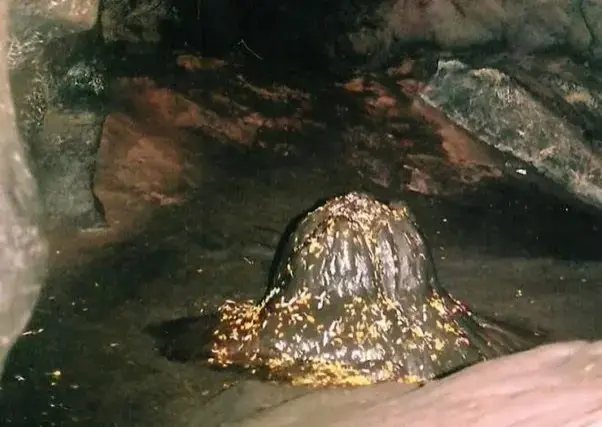
Patal Bhuvaneshwar is a remarkable natural limestone cave in Uttarakhand, reached through a narrow underground passage. According to the Incredible India tourism site, the cave extends approximately 90 feet below the entrance and contains fascinating limestone formations, including stalactites and stalagmites.
What makes the cave especially significant to devotees is the way some of these natural formations are understood through religious tradition. One formation is traditionally identified as Adi Ganesh, while another lotus-like formation above it is associated with Brahma Kamal. Water droplets are said to fall from above onto the formation below, and devotees regard this recurring flow as sacred.
It is important to distinguish between geology and religious interpretation. The formations themselves are naturally created limestone structures. Their identification as Adi Ganesh and Brahma Kamal comes from local religious tradition and devotional belief.
This meeting of natural wonder, mythology, and faith is what makes Patal Bhuvaneshwar a fascinating sacred site, where the formations of the earth are experienced through centuries-old spiritual
From King Rituparna to Adi Shankaracharya — Who Discovered This Cave?
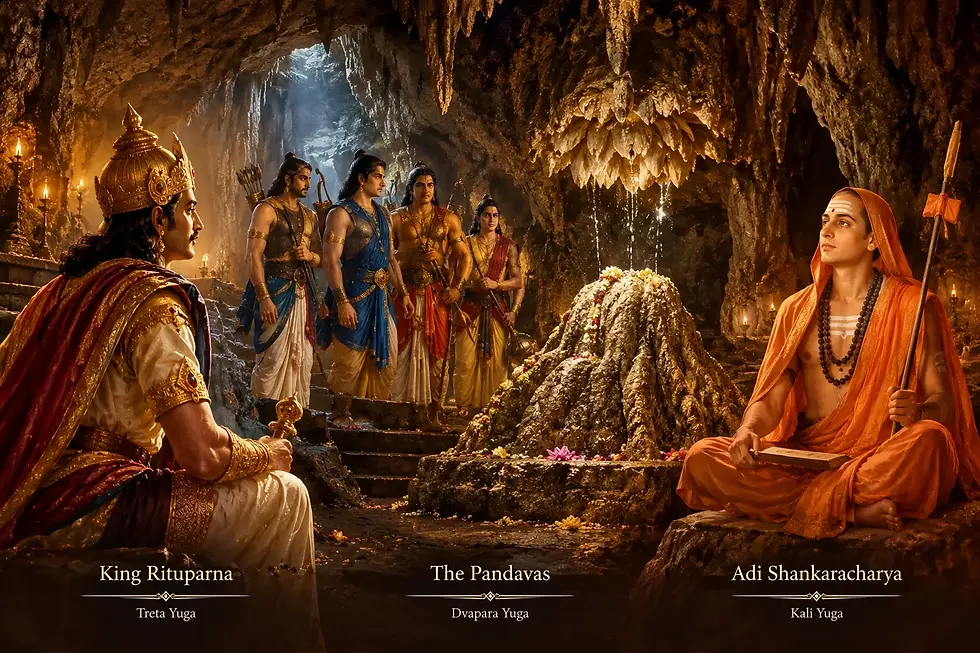
Patal Bhuvaneshwar has a rich traditional history that connects the cave with several important figures and periods of Hindu tradition. These accounts are preserved through religious texts, local beliefs, and pilgrimage traditions.
According to tradition, King Rituparna of the Solar dynasty visited the cave during the Treta Yuga. The cave is later associated with the Pandavas during the Dvapara Yuga. These traditions are connected with the Manas Khand section of the Skanda Purana.
The cave is also traditionally associated with Adi Shankaracharya. Uttarakhand Tourism notes that it is believed that Shankaracharya visited the cave and also mentions its connection with the Manas Khand of the Skanda Purana.
The traditional timeline can be understood as:
Treta Yuga – King Rituparna: Traditionally believed to have visited Patal Bhuvaneshwar.
Dvapara Yuga – Pandavas: The cave is associated with the Pandavas in local and religious tradition.
Kali Yuga – Adi Shankaracharya: Tradition connects the cave with the revered philosopher and spiritual teacher.
Today – Pilgrimage: Patal Bhuvaneshwar continues to attract devotees and visitors.
The Hidden Marvels of Patal Bhuvaneshwar Cave
Adi Ganesh is only one of the many formations associated with the cave.
Traditional interpretations identify natural formations with Sheshnag, Shiva's matted hair, various deities, the four Yugas and other sacred figures. The Pithoragarh district administration specifically notes that the main passage opens into smaller caves containing stone formations interpreted as traditional Hindu gods and goddesses.
The cave is therefore not a conventional temple built entirely with carved statues. Much of what visitors see is natural limestone shaped by geological processes and subsequently understood through religious symbolism.
This makes the site especially interesting: nature created the forms, while faith gave them sacred stories.
The Enduring Fascination of Patal Bhuvaneshwar
The Patal Bhuvaneshwar story continues to fascinate devotees because it brings together faith, mythology and the wonder of a natural cave. For many pilgrims, it is not just a place to visit but a journey into the sacred stories they have heard since childhood.
Here are the main reasons why the tradition still draws people:
A new chapter to a familiar legend: Almost every Hindu household knows how Ganesha received the head of an elephant. The Patal Bhuvaneshwar tradition adds the belief that his original head, or a sacred representation of it, is worshipped here as Adi Ganesh.
A cave that feels sacred: Visitors descend into a limestone cave in the Pithoragarh district of Uttarakhand. The darkness, silence and cool air deepen the feeling of entering another world.
Formations with stories: Generations of devotees have linked the natural rock shapes to gods, sacred animals and scenes from Hindu mythology.
Faith beyond proof: No archaeological evidence shows that Ganesha's physical head is preserved here, and devotees do not look for it. For them, the cave is a sacred symbol of their heritage.
The pull of the unseen: The idea of a hidden shrine deep underground stirs curiosity and draws pilgrims and travellers year after year.
Together, these elements explain why the story remains alive. The cave is a natural wonder, but it is the devotion of generations that has made it a place of worship and wonder.
The Human-Faced Ganesha Temple
The best-known human-faced Ganesha shrine is the Adi Vinayagar Temple in Tamil Nadu. It stands in the Muktheeswarar temple complex near Thilatharpanapuri, close to Koothanur. Travel listings place it near Poonthottam in the Thiruvarur district. The Adi Vinayaka shrine is just outside the main Muktheeswarar temple.
Here, Ganesha is worshipped not as the elephant-headed Gajanana but as Nara Mukha Vinayagar, meaning "human-faced Vinayagar". The name comes from nara (human) and mukha (face). Devotees regard this as the form Ganesha had before he received the elephant head, which links the temple to the Patal Bhuvaneshwar story of Adi Ganesh.

What makes this temple special
A rare form of Ganesha: It is one of very few shrines where he is worshipped with a human face. The idol is about five feet tall, with a serpent ornament around its waist.
An ancient shrine: The temple's origins are said to predate the 7th century, which would make it one of Tamil Nadu's oldest Ganesha temples.
A sacred setting: The nearby Muktheeswarar temple is a Devara Sthalam, praised in the Devaram hymns and dedicated to Lord Shiva.
Ritual connection: The name Thilatharpanapuri comes from thil (sesame) and tharpana, the ritual of offering tribute to ancestors. Many devotees visit to perform these ancestral rites.
Regular worship: Special pujas are held for Adi Vinayagar on Thursdays. The main festivals are Maha Shivaratri and Ganesha Chaturthi.
Beliefs of devotees: Devotees believe that worship here brings peace in family relations and improves children's memory.
The temple's age and the story of Ganesha's human form come from tradition and temple accounts, not from verified historical records. Writing them as "devotees believe" or "it is said" keeps your blog consistent with the careful tone of your Patal Bhuvaneshwar section.
A Naramuga Vinayakar temple is also listed at Chidambaram, but I'd suggest verifying details before including it.
Conclusion
Patal Bhuvaneshwar is a real natural limestone cave and an officially recognized religious site in Uttarakhand. The belief that Ganesha's original head is preserved there belongs to the site's sacred tradition and should be presented as a religious belief rather than a scientifically proven discovery.
The natural formation worshipped as Adi Ganesh, the water dripping from the lotus-like rock above it, the legends of Rituparna and the Pandavas, and the tradition connecting the cave with Adi Shankaracharya have made Patal Bhuvaneshwar one of India's most intriguing sacred cave sites.
"THE MYSTERY BEHIND GANESHA'S ORIGINAL HEAD"
FAQs
What is Patal Bhuvaneshwar?
Patal Bhuvaneshwar is a natural limestone cave in the Pithoragarh district of Uttarakhand, reached through a narrow underground passage. It is an officially recognized underground Shiva shrine that extends roughly 90 feet below the entrance and contains natural formations such as stalactites and stalagmites, several of which are worshipped as sacred figures.
What is Adi Ganesh?
Adi Ganesh refers to a rock formation inside Patal Bhuvaneshwar that devotees believe represents Lord Ganesha's original head, the one severed by Shiva before Ganesha was restored to life with the head of an elephant. This is a religious belief and traditional interpretation of a natural cave formation, not a scientifically verified discovery.
What is the Brahma Kamal formation above Adi Ganesh?
Above the Adi Ganesh formation hangs a lotus-like rock structure associated with Brahma Kamal. Water droplets are said to fall from this formation onto the stone below, and devotees regard this continuous drip as sacred.
Is there scientific proof that Ganesha's head is inside the cave?
No. The formations at Patal Bhuvaneshwar are naturally created limestone structures. Their identification as Adi Ganesh, Brahma Kamal and other deities comes from local religious tradition and devotional belief, not from archaeological or scientific evidence.
What other deities or figures are found inside the cave?
Along with Adi Ganesh, traditional interpretations identify natural formations with Sheshnag, Shiva's matted hair, the four Yugas, and various other gods and goddesses. The main passage opens into smaller caves containing further stone formations interpreted through Hindu mythology.
Where is the Adi Vinayagar Temple, and how is it connected to Patal Bhuvaneshwar?
The Adi Vinayagar Temple is located near Thilatharpanapuri, close to Koothanur and Poonthottam in the Thiruvarur district of Tamil Nadu, within the Muktheeswarar temple complex. Here Ganesha is worshipped as Nara Mukha Vinayagar, or the human-faced Vinayagar, believed to be the form he had before receiving the elephant head, which links the temple's tradition to the Adi Ganesh story at Patal Bhuvaneshwar.
Is Patal Bhuvaneshwar a man-made temple?
No. It is a natural limestone cave rather than a conventional temple built with carved statues. Most of what visitors see is limestone shaped by geological processes over time, which devotees have come to understand and worship through Hindu religious symbolism.

Comments