
Poombarai Kuzhandhai Velappar Temple – A Special Murugan Temple in the Hills

If you're travelling towards Kodaikanal and looking for something beyond the usual tourist spots, Poombarai is worth a stop. It's a small hill village surrounded by the greenery of the Western Ghats, and right in the middle of it stands the Kuzhandhai Velappar Temple. A Murugan temple known for its deep connection to the Siddha tradition, its old sculptures, and centuries of belief.
Quick facts about the temple:
Located in Poombarai village, about 18 km west of Kodaikanal, Dindigul district
Believed to be around 3,000 years old
Inscriptions suggest it was originally built by the Chera kings in the 5th century CE
Managed today by the Palani Devasthanam
Said to be located directly opposite the Palani Dandayudhapani temple
The Story Behind the Name
There's a well-known legend connected to Arunagirinathar, the famous 15th century Tamil poet-saint known for his devotional songs on Murugan. According to the story, one night while he was resting in the mandapam of this temple, a demon tried to kill him. At that moment, Murugan is said to have appeared in the form of a small child and saved his life. It's because of this incident that the main deity here came to be called "Kuzhandhai Velappar". Which literally means "the Child holding the Spear."
Siddar Bogar and the Navapashanam Idol
The most special thing about this temple. The reason it stands apart from most other Murugan temples is how the idol itself was made. Bogar, one of the famous 18 Siddhars, is said to have travelled to the Kodaikanal hills in search of a rare stone called anjanakkal (a kind of kohl-stone found in nature).
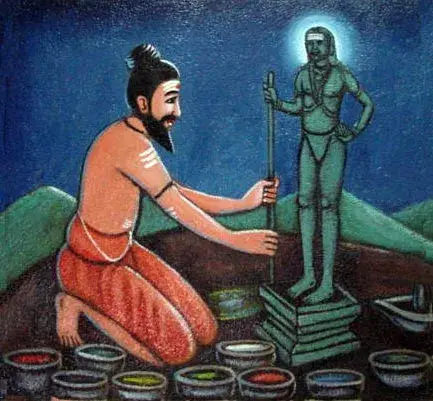
When he discovered it in Poombarai, he decided to stay back and used it to create the idol through a process called Navapashanam, a careful mix of nine different minerals and herbs, several of which are actually poisonous in their raw form. Combining and purifying them into a single sculpture was done using a secret alchemical method known as "Kurumuppu," which is considered part of the traditional science passed down by the Siddhars.
Because of this rare method, the Poombarai Kuzhandhai Velappar idol is often mentioned in the same breath as other famous Navapashanam idols like the ones at Tirupati Ezhumalaiyan, Guruvayurappan, and Palani Dandayudhapani. Devotees believe idols made this way carry a special spiritual energy that ordinary stone or metal idols don't have.
What the Deity Looks Like
The idol in the sanctum looks quite similar to the Palani deity standing with a staff (vel) in the right hand, and the left hand resting on the thigh. But if you look closely, there's a difference in posture: the Palani idol stands in a slightly bent pose called tribhanga, while the Poombarai idol stands upright and straight, in what's called samapada posture. The deity here is depicted as a young boy bald-headed, wearing a rudraksha mala, dressed simply in the style of an ascetic. This youthful, humble form is part of why devotees feel such a close, personal connection to this Murugan.
Temple Layout and Carvings
The temple follows a traditional layout, with the mukha mandapam, maha mandapam, an inner corridor, and the main sanctum all arranged one after another in a straight line. The sanctum itself is built of black granite, topped with a single-tier tower (vimanam) made of lime plaster, which rises to a four-sided spire with a metal kalasam at the very top. Just north of the sanctum, facing east, there's a small shrine for Shiva. Around the main shrine, in the surrounding courtyard, you'll also find smaller shrines dedicated to Vinayagar, Bhairavar, the Navagrahas, Idumban, Nagar (serpent deity), Arunagirinathar, Mallar, and Bhadrakaliamman.
The wall carvings around the temple, done in the Nayak-era style, are worth spending some time looking at. They show a whole range of scenes a hunter shooting an arrow at a meditating sage, a tiger hunt, musicians playing the mridangam and thappu, a musician playing a peacock-shaped veena, the story of Kannappa Nayanar, a cow pouring milk over a lingam, warriors riding elephants and horses, sword fights, and even simple everyday scenes like a cowherd grazing cattle. It's a nice mix of mythology, religion, and everyday village life, all carved into stone by craftsmen of that era.
The Sacred Tree and Festival

The sacred tree (sthala vriksham) of this temple is the Kurinji plant, the same flower the Western Ghats are famous for it blooms only once every 12 years, which makes it quite special. Every year, during the Tamil month of Thai or Maasi, on Kettai star day (which falls after Thaipoosam), the temple celebrates a 10-day festival that ends with a grand car festival (ther thiruvizha), drawing devotees from the surrounding hill villages and beyond.
Known for Curing Illness
Many people believe that the Navapashanam idol has a natural cooling effect and has the power to absorb the ailments and troubles of devotees who come here. During abhishekam, honey and sandalwood paste are applied to the idol, and these are later given out as prasadam believed by devotees to have real healing properties. This is one of the main reasons the temple is also referred to locally as a "noi theerkum thalam," or a place where illnesses are cured.
Poombarai Kuzhandhai Velappar Temple
If you're already planning a trip to Kodaikanal, it's worth taking the short detour to Poombarai. Between the cool hill air, the quiet village setting, the mystery around the Siddha-made idol, and centuries of devotion built into every stone here, this temple offers something a lot more meaningful than just another stop on the map.
FAQs
Where is Poombarai Kuzhandhai Velappar Temple located?
It's in Poombarai village, about 18 km west of Kodaikanal, in Dindigul district, Tamil Nadu.
How old is the temple?
It's believed to be around 3,000 years old, with inscriptions suggesting it was originally built by the Chera kings in the 5th century CE.
Who manages the temple today?
It is managed by the Palani Devasthanam and is said to be located directly opposite the Palani Dandayudhapani temple.
Why is the deity called "Kuzhandhai Velappar"?
The name comes from a legend involving Arunagirinathar, the 15th-century Tamil poet-saint. According to the story, Murugan appeared as a small child and saved him from a demon attack while he rested in the temple's mandapam. Hence "the Child holding the Spear."
What makes this temple's idol so special?
The bronze idol is a Navapashanam idol, created by the Siddhar Bogar using a rare mix of nine minerals and herbs (some poisonous in raw form), purified through a secret alchemical process called "Kurumuppu." It's considered part of the traditional Siddha science.
Are there other famous Navapashanam idols like this one?
This idol is often mentioned alongside other well-known Navapashanam idols such as those at Tirupati Ezhumalaiyan, Guruvayurappan, and Palani Dandayudhapani.
How does the Poombarai idol differ from the Palani idol?
Both show Murugan holding a vel (staff) in the right hand with the left resting on the thigh, but the Palani idol stands in a bent tribhanga pose, while the Poombarai idol stands upright in samapada posture. The Poombarai deity is also depicted as a bald-headed young ascetic wearing a rudraksha mala.
What can visitors see in the temple's wall carvings?
The Nayak-era carvings depict scenes like a hunter aiming at a meditating sage, a tiger hunt, musicians playing mridangam and a peacock-shaped veena, the story of Kannappa Nayanar, warriors on elephants and horses, and everyday scenes like cattle grazing.
When is the temple festival celebrated?
A 10-day festival is held every year during the Tamil month of Thai or Maasi, on Kettai star day (after Thaipoosam), ending with a grand car festival (ther thiruvizha).
Where are these idols typically made?
Swamimalai in Tamil Nadu is the best-known center for traditional bronze and panchaloha idol-making, with families practicing this craft for generations. There are also skilled workshops in and around Chennai and other parts of Tamil Nadu.
Does a handcrafted idol carry the same significance as an original Navapashanam idol like Palani's?
Not in the same historical or spiritual sense. The temple Navapashanam idols are believed to be centuries old and tied to specific Siddha lineages and legends. A newly handcrafted idol is a beautiful, traditionally-made devotional object in its own right, but it wouldn't carry that same specific Navapashanam history or claimed properties.


Comments