
The Five Forms of Hanuman — One Devotee, Many Divine Expressions

Lord Hanuman is one of the most beloved deities in Hindu tradition, yet he is rarely shown the same way twice. Sometimes he stands fearless with a hand raised in protection. Sometimes he folds his hands in quiet devotion. Sometimes he sits in deep meditation, or appears with five faces looking in every direction, or flies through the sky carrying an entire mountain. Each of these is a true and complete form of Hanuman, yet each tells a very different part of his story.
Why does one deity appear in so many forms? In this blog, we bring together five of Hanuman's most beloved forms, Abhaya Anjaneyar, Bhakta Anjaneyar, Dhyana Anjaneyar, Panchamukha Anjaneyar and Sanjeevini Anjaneyar, to understand what each one represents and why, together, they offer such a complete picture of devotion, strength and divine service.
What Makes Hanuman's Five Forms So Significant?
Each form shows a different side of the same divine personality.
Abhaya Anjaneyar – courage and protection.
Bhakta Anjaneyar – devotion and surrender.
Dhyana Anjaneyar – meditation and concentration.
Panchamukha Anjaneyar – multiple forms of divine protection and power.
Sanjeevini Anjaneyar – determination and life-saving service.
This is what makes Hanuman iconography so fascinating. The deity does not appear in only one visual language. Different forms allow devotees to connect with different qualities of his character.
1. Abhaya Anjaneyar – Why Does Hanuman Stand as a Fearless Protector?
What Is the Abhaya Mudra?
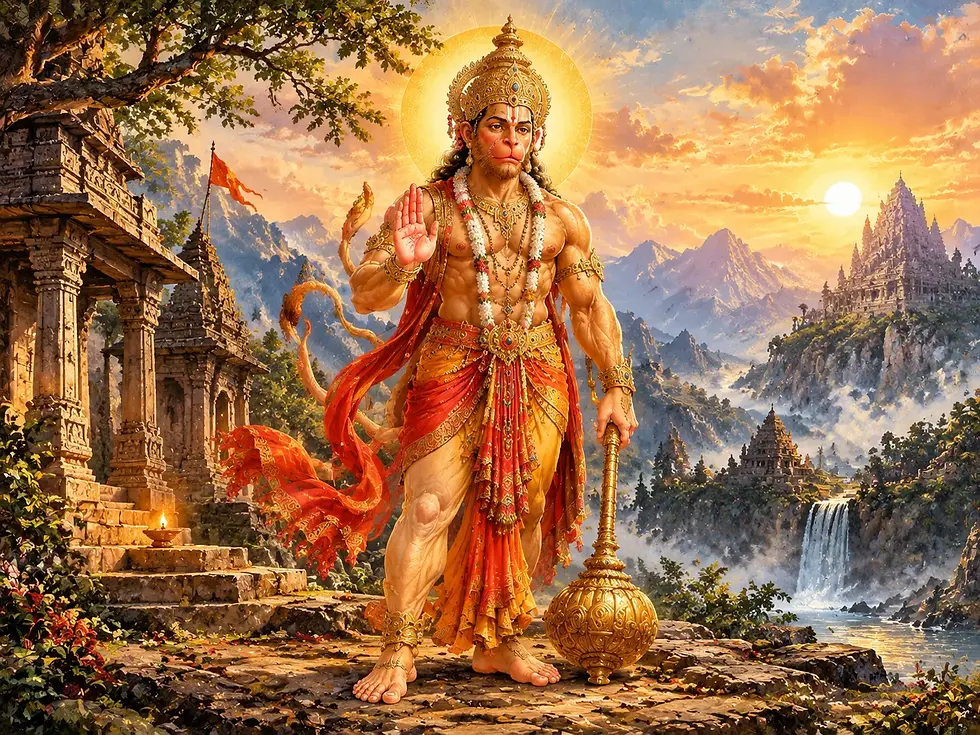
The word abhaya means fearlessness or freedom from fear, and the mudra, or hand gesture, involves the right hand raised with the palm facing outward, fingers pointing upward. This ancient gesture is found across Hindu and Buddhist traditions and carries one consistent meaning everywhere it appears: "Do not be afraid. I am here to protect you."
When Hanuman is shown with this gesture, it is not a threat or a warning to anyone. It is a reassurance, a promise of safety extended to every sincere devotee who comes to him. Alongside the raised hand, he is often shown standing firm, sometimes with his mace (gada) resting nearby, ready to be used the moment protection is needed, yet held back in calm readiness rather than aggression.
The Roots of Hanuman's Fearlessness
Hanuman's fearless nature is shown again and again throughout the Ramayana. He leapt across the vast ocean to Lanka without hesitation, faced the demoness Surasa and the rakshasi Simhika who tried to stop him mid-flight, entered Ravana's heavily guarded kingdom alone to search for Sita, allowed himself to be captured and his tail set on fire, only to use the flames to burn down part of Lanka, and fought fearlessly in the war that followed, including the daring mission to bring back the Sanjeevini mountain.
At no point in these stories does Hanuman act out of fear for himself. Every action comes from devotion to Rama and concern for others, never self-preservation. This is the foundation of Abhaya Anjaneyar: a fearlessness that comes not from recklessness, but from complete faith and selfless purpose. When the mind is anchored in devotion rather than ego, fear naturally has less power over it.
Why Devotees Turn to Abhaya Anjaneyar
This form of Hanuman is especially popular among those facing difficult or threatening situations in life. Devotees pray to Abhaya Anjaneyar for:
Protection from enemies and harm: whether physical danger, legal troubles, or ill-intentioned people, this form is invoked for safety and shielding.
Freedom from fear and anxiety: many turn to this form when struggling with worry, stress, or a restless, fearful mind.
Protection from negative energies: like several of Hanuman's forms, Abhaya Anjaneyar is believed to guard homes and individuals against evil eye, black magic and ill fortune.
Courage in difficult decisions: when facing a challenge that requires boldness, be it a new job, a health scare, or a major life change, devotees seek his blessing for the courage to move forward.
Fearlessness as a Spiritual Teaching
Beyond protection from external dangers, Abhaya Anjaneyar carries an inner teaching as well. True fearlessness, as Hanuman shows us, does not come from denying danger or pretending difficulties do not exist. It comes from being so firmly rooted in purpose, devotion and faith that fear loses its grip on the mind.
This form reminds devotees that courage is available to everyone, not just to those blessed with great physical strength. A person steady in their values, clear in their purpose and sincere in their devotion can stand just as fearlessly in the face of life's challenges as Hanuman stood before Lanka's armies. Fear shrinks naturally when the heart is full of faith rather than self-doubt.
2. Bhakta Anjaneyar – Why Does Hanuman Stand With Folded Hands?
Who Is Bhakta Anjaneyar?
The word bhakta means devotee, and this form of Hanuman represents devotion in its purest, most complete expression. Unlike the fierce, flying, or battle-ready forms of Hanuman, Bhakta Anjaneyar shows no action at all. He simply stands, hands folded in anjali mudra, the universal gesture of respect, surrender and prayer, facing his beloved Lord Rama.
This posture is often shown at the feet of Rama, Sita and Lakshmana, or sometimes alone, with the heart turned entirely toward them even in their absence. It is this image that is most commonly placed in temples and homes, because it captures something every devotee can relate to: the simple, humble act of standing before the divine with love and surrender.

The Meaning Behind Folded Hands
Folded hands, or anjali mudra, are found across many spiritual traditions, and the gesture carries rich meaning in Hanuman's case specifically:
Surrender of the self: Folded hands symbolise setting aside one's own will, ego and desires, offering oneself entirely in service to the divine.
Respect and reverence: The gesture shows humility, honour and gratitude, a recognition that Hanuman, despite his immense power, chooses to place himself in service rather than above others.
Readiness, not passivity: Though his hands are folded and his body still, this is not a position of weakness or inaction. It is the stance of someone fully present and instantly ready to serve the moment he is called upon, as he does throughout the Ramayana.
Union of heart and body: The hands joined at the chest, near the heart, reflect an inner state matching the outer gesture, where love, loyalty and focus all point in one direction, toward Rama.
Why This Form Speaks to So Many Devotees
Among all the dramatic stories of Hanuman, from crossing the ocean to lifting mountains to defeating powerful demons, Bhakta Anjaneyar is often the form devotees feel closest to. There is something deeply relatable about a figure who, despite extraordinary ability, chooses humility and quiet devotion as his truest expression.
This form reminds us that devotion does not always need to be loud, dramatic or action-packed. Sometimes, the deepest love is expressed simply by showing up, standing still, and giving one's full attention and respect to what matters most. For many, this is also why Bhakta Anjaneyar feels so approachable as a daily companion in prayer, someone who does not demand grand gestures, only a sincere heart.
Lessons From Bhakta Anjaneyar
True strength includes humility. Hanuman's power is never in question, yet he chooses a posture of complete humility before Rama. Strength and humility are not opposites; they belong together.
Devotion is a daily practice, not just a crisis response. While many stories show Hanuman in action during emergencies, this form shows devotion as a constant, quiet presence, practiced even in ordinary, uneventful moments.
Service begins with presence. Before any task, any mission or any rescue, Hanuman's devotion starts simply with standing close, attentive and ready. Presence itself is a form of service.
Respect elevates relationships. Whether toward the divine, elders, teachers or loved ones, the gesture of folded hands reminds us that honouring others with sincerity strengthens every bond.
3. Dhyana Anjaneyar – What Happens When Hanuman Becomes Completely Still?
Lord Hanuman in motion: leaping across oceans, lifting mountains, battling demons, or standing alert with his mace. But there is another form of Hanuman that is completely different, and in many ways just as powerful. This is Dhyana Anjaneyar, Hanuman seated in deep meditation, eyes closed, hands folded or resting gently, body utterly still.
At first glance, a meditating Hanuman can feel like a contradiction. How can the restless, mighty vanara who tore through the skies also be shown sitting in perfect silence? Yet this form holds one of the deepest teachings in his story. In this blog, we explore what Dhyana Anjaneyar represents, why stillness matters as much as strength, and what this quiet form of Hanuman teaches us about devotion.

Who Is Dhyana Anjaneyar?
Dhyana Anjaneyar depicts Hanuman in a yogic, meditative posture, often seated cross-legged with his palms joined or resting on his knees, his face calm and his eyes gently closed or half-closed, lost in inward focus. Unlike the dynamic images of him flying or fighting, this form shows Hanuman turned completely inward, absorbed in the remembrance of Lord Rama.
In this state, Hanuman is not performing any outward action. There is no mission, no battle, no journey. And yet tradition holds that this stillness is not empty or passive. It is considered one of the most powerful states a devotee can reach, a state of total surrender and uninterrupted connection with the divine.
Hanuman as the Ultimate Yogi
Although Hanuman is widely celebrated for his physical feats, scriptures and devotional traditions also describe him as a great yogi, deeply learned in the scriptures, music, grammar and the science of the self. He is sometimes referred to as a master of the eight yogic siddhis (supernatural powers) and the nine forms of devotion (navavidha bhakti).
Dhyana Anjaneyar reflects this lesser-known side of Hanuman: not just the devoted servant who acts without hesitation, but also the disciplined yogi who has mastered his mind, breath and senses. In this form, his incredible strength is not absent, it is simply turned inward, held in complete stillness and control.
What Happens When Hanuman Becomes Still?
This is the heart of the Dhyana Anjaneyar form. When Hanuman stops moving outwardly, something significant happens inwardly:
Action gives way to presence. Instead of doing something for Rama, Hanuman simply exists in Rama's remembrance. Devotion here is not a task to complete but a state to dwell in.
Power is not lost, it is gathered. A meditating Hanuman is not a weaker Hanuman. His strength, courage and energy do not disappear; they settle inward, like a coiled spring, available but completely under his command.
The mind becomes one-pointed. In his many adventures, Hanuman's mind was fully focused on his task, whether crossing the ocean or searching for Sita. In meditation, that same one-pointed focus turns toward Rama alone, without any external goal.
Devotion deepens into union. Where active service (seva) expresses love through action, meditation (dhyana) expresses love through presence. Together, they show that complete devotion includes both doing and simply being.
The Balance Between Action and Stillness
Hanuman's life beautifully illustrates a balance that many spiritual traditions point to: the balance between karma (action) and dhyana (meditation). He is remembered as someone who could fly across oceans in moments and carry entire mountains, yet he could also sit in such deep stillness that his breath and mind would settle completely.
This balance carries a lesson for everyday life too. Constant action without inner stillness can lead to exhaustion and a scattered mind. Stillness without the willingness to act, on the other hand, can become mere escape. Dhyana Anjaneyar reminds us that true strength comes from being able to move powerfully into action when needed, and just as powerfully withdraw into calm, focused stillness when the moment calls for it.
4. Panchamukha Anjaneyar – Why Does Hanuman Have Five Faces?
The Story Behind Panchamukha Anjaneyar
The legend comes from the Patala Khanda episode of the Ramayana, during the war between Rama and Ravana. When Rama and Lakshmana were captured by Ahiravana, the sorcerer-king of Patala (the netherworld) and brother of Mahiravana, Hanuman set out to rescue them.
Ahiravana kept his life force protected by five lamps, each burning in a different direction, and the only way to defeat him was to extinguish all five lamps at exactly the same moment. A single pair of hands and a single face would not have been enough to reach and blow out five lamps placed far apart from one another at once.
To accomplish this impossible task, Hanuman took on the form of Panchamukha Anjaneyar, manifesting five faces at once, each facing a different direction. With this form, he was able to extinguish all five lamps simultaneously, defeat Ahiravana, and rescue Rama and Lakshmana. This is why Panchamukha Hanuman is seen as the ultimate symbol of using combined strength, strategy and divine power to overcome an enemy that could not be defeated through ordinary means.

The Five Faces and What They Represent
Each of the five faces of Panchamukha Anjaneyar belongs to a different form, facing a specific direction, and each carries its own blessing.
1. Hanuman Face (facing east)
The central face is Hanuman's own, calm and devoted. It represents unwavering devotion (bhakti) to Lord Rama and is said to remove the fear of enemies and negative energies.
2. Narasimha Face (facing south)
The fierce lion face of Narasimha, the man-lion avatar of Vishnu, faces south, the direction associated with Yama, the god of death. This face is believed to remove fear of death and protect devotees from harm and danger.
3. Garuda Face (facing west)
The eagle face represents Garuda, the vahana of Vishnu, known for his power to counter poison and negative, harmful energies. This face is associated with protection from black magic, curses and ill wishes.
4. Varaha Face (facing north)
The boar face represents Varaha, another avatar of Vishnu, who is associated with prosperity, strength and wellbeing. This face is said to bless devotees with good health, wealth and the removal of obstacles in daily life.
5. Hayagriva Face (facing upward)
The horse face represents Hayagriva, the avatar of Vishnu associated with knowledge and wisdom. Facing the sky, this face is believed to grant learning, clarity of mind and success in education and spiritual pursuits.
Why Five Faces? The Deeper Symbolism
Beyond the story of Ahiravana, the five faces of Panchamukha Anjaneyar carry a layered spiritual meaning:
Protection in all directions: With faces looking east, south, west, north and upward, this form represents complete, all-round protection, leaving no direction unguarded.
Unity of divine powers: Each face belongs to a different form of Vishnu or a related deity, showing that Hanuman carries within him the combined strength, wisdom and grace of many divine forms, all channelled through his devotion.
Victory over the impossible: The story reminds devotees that some problems cannot be solved with the tools we usually rely on. Sometimes what is needed is a shift in perspective, a combination of strengths, and the courage to approach a challenge from every angle at once.
Devotion as the uniting force: Even with five powerful faces, it is Hanuman's devotion to Rama that holds the form together and gives it purpose. Power without devotion, the story suggests, is incomplete.
Panchamukha Anjaneyar is far more than a striking image with five faces. It is a story of determination, the coming together of many strengths for one purpose, and the power of devotion to overcome challenges that seem impossible. Each face, looking in its own direction, reminds us that true protection comes from being alert, balanced and grounded in devotion from every side of life.
May the five-faced Hanuman bless us all with courage, protection and unwavering faith, just as he protected Rama and Lakshmana in their moment of greatest need.
Jai Panchamukha Hanuman!
5. Sanjeevini Anjaneyar – Why Is Hanuman Shown Carrying a Mountain?
The Story Behind Sanjeevini Anjaneyar
The episode takes place during the great war between Rama's army and Ravana's forces in Lanka. In the midst of the battle, Ravana's son Indrajit (Meghnad) struck down Lakshmana with a powerful weapon, the Shakti Astra, leaving him gravely wounded and close to death. The entire army of Rama fell into despair, as Lakshmana's life hung by a thread.
The physician Sushena was consulted, and he revealed that only a rare set of life-restoring herbs growing on a mountain in the Himalayas, specifically the Sanjeevini herb (also called Mrita Sanjeevani, meaning "one that revives the dead") could save Lakshmana, and only before sunrise. The mountain in question was Dronagiri, located far away near the Himalayas.
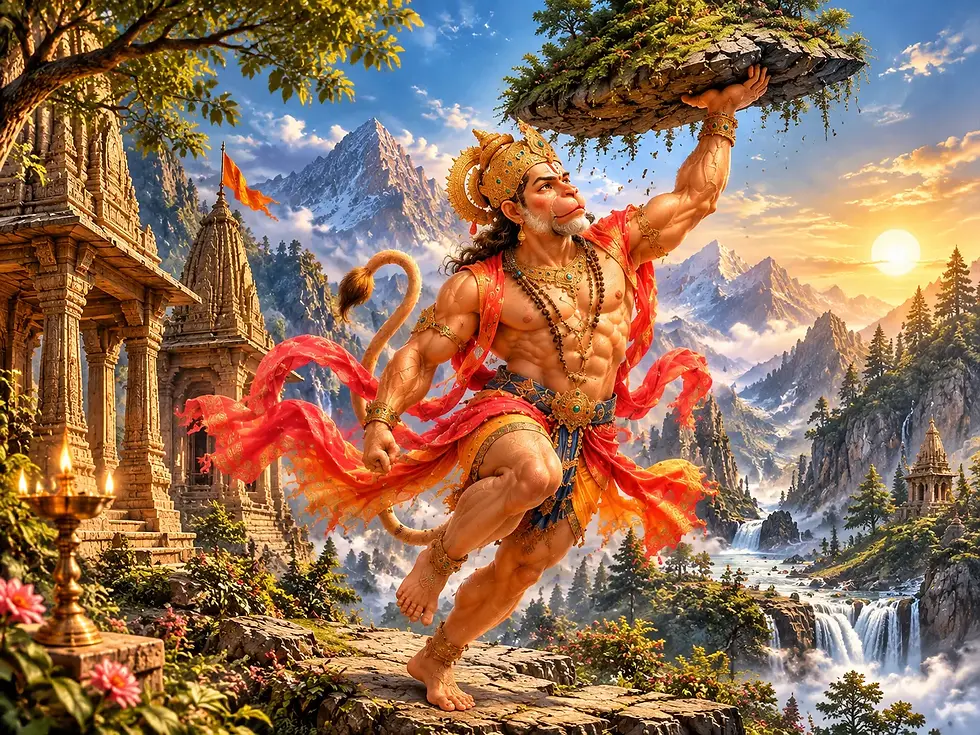
Hanuman, known for his unmatched speed and strength, immediately set off on this urgent mission. He flew across the skies to the Himalayas to find the mountain. But when he reached Dronagiri, he could not identify the exact Sanjeevini herb among the many plants growing there. With time running out and sunrise approaching, Hanuman made a bold decision: rather than risk choosing the wrong herb, he lifted the entire mountain, roots and all, and carried it back to Lanka. Sushena was then able to identify and use the correct herb, and Lakshmana was revived in time, saving the day for Rama's army.
Why Did Hanuman Carry the Whole Mountain?
This is the question many people ask, and the answer reveals a lot about Hanuman's character. He could not recognise the exact herb among the many plants on the mountainside, and there was no time to waste searching, questioning or making mistakes, since even a small delay could have cost Lakshmana his life.
Rather than take any chance with something so precious, Hanuman chose the most certain solution available to him: he brought the entire source. This decision shows a mind that prioritises the goal over ego, over convenience, and over the need to appear clever. It was not about proving his strength, though his strength made it possible. It was about making absolutely sure that his friend would be saved.
What This Image Teaches Us
The image of Hanuman carrying the mountain has inspired devotees for centuries, and it carries lessons that go well beyond the story itself.
Total commitment: When someone we love is in danger, half measures are not enough. Hanuman's response was complete and immediate, holding nothing back.
Humility in strength: Despite being capable of extraordinary feats, Hanuman did not let pride or overconfidence cause him to guess at the herb. He chose certainty over the risk of being wrong.
Selfless service: Hanuman's entire mission was for Lakshmana's sake, with no personal benefit to himself. This is why he is seen as the ultimate example of selfless devotion and service, or seva.
Speed guided by purpose: Hanuman is known as one of the fastest beings in the Ramayana, but this story shows that his speed was always paired with purpose and devotion, never used carelessly.
Problem-solving under pressure: Faced with an impossible deadline and an unfamiliar task, Hanuman found a practical, if unconventional, solution rather than freezing or giving up.
Sanjeevini Anjaneyar, carrying an entire mountain across the sky, is one of devotion's most powerful pictures. It reminds us that when someone we care about is in need, we should give our fullest effort, without hesitation, without ego, and without cutting corners. Hanuman's choice to lift the whole mountain rather than risk the wrong herb still speaks to anyone facing a crisis today: when it truly matters, do not take chances with half-measures.
Where to See These Five Forms Across India
Each of these forms is worshipped at specific temples across the country, some ancient, some built in more recent memory, each drawing devotees who feel a pull toward that particular expression of Hanuman.
Abhaya Anjaneyar: Jakhoo Temple, Shimla, Himachal Pradesh, home to a towering 108-foot hilltop statue of Hanuman standing in protection over the town.
Bhakta Anjaneyar: Hanumangadhi, Ayodhya, Uttar Pradesh, one of the most visited and beloved shrines of devoted Hanuman worship in North India.
Dhyana Anjaneyar: Prasanna Yoga Anjaneyar Temple, Chromepet, Chennai, dedicated specifically to the meditative, yogic form of Hanuman.
Panchamukha Anjaneyar: Sri Panchamukha Anjaneyaswami Temple, Kumbakonam, Tamil Nadu, and Panchamukhi near Mantralayam, Karnataka, the place where the saint Raghavendra Swami meditated on this five-faced form.
Sanjeevini Anjaneyar: Sanjeevani Hanuman Temple at Manki Point, Kasauli, Himachal Pradesh, believed to mark the spot where Hanuman's foot touched down while carrying the Sanjeevini mountain.
Conclusion
Hanuman's many forms are not a sign of a divided nature, but of a complete one. Abhaya, Bhakta, Dhyana, Panchamukha and Sanjeevini Anjaneyar are five faces of the same boundless devotion, each shining light on a different quality that lives within the same devoted heart. Together, they remind us that true strength is never one-dimensional, and that the deepest devotion knows how to be fearless and humble, active and still, all at once.
May all five forms of Hanuman bless us with courage, humility, inner peace, protection and unwavering devotion in every part of our lives. Jai Hanuman!
FAQs
What are the five forms of Hanuman?
The five forms discussed in this article are Abhaya Anjaneyar, Bhakta Anjaneyar, Dhyana Anjaneyar, Panchamukha Anjaneyar, and Sanjeevini Anjaneyar.
Are these the only forms of Hanuman?
No. Hanuman is represented in many different forms across Hindu traditions, temples, scriptures, and regional practices. These five are selected based on their distinctive devotional and artistic representations.
Why are different forms of Hanuman worshipped?
Different forms highlight different qualities traditionally associated with Hanuman, including devotion, courage, protection, meditation, strength, and selfless service.
Is a brass Hanuman statue suitable for a home temple?
A traditionally crafted brass Hanuman statue can be placed in a home shrine as part of devotional worship, according to the family's religious customs.
Can Hanuman bronze statues be made in Chola-style sculpture?
Yes. Hanuman can be represented using traditional South Indian sculptural aesthetics, including details inspired by the Chola bronze statue tradition. The exact form and iconography can vary according to the sculptural tradition.
Comments